India, startups, and women in the labor market. What do they have in common?
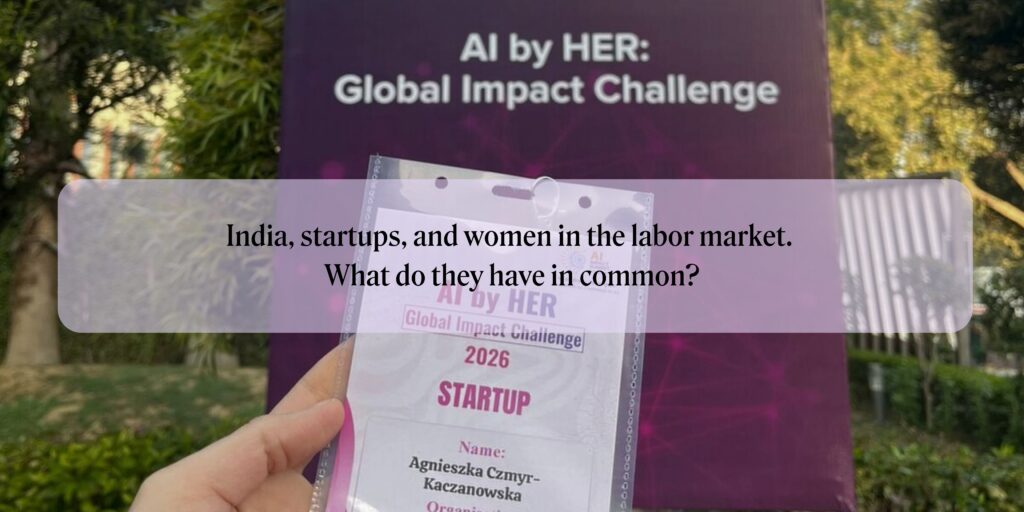
We went to India for the AI by HER competition as part of the AI Impact Summit 2026 (at the special invitation of the Ministry of Electronics and Information Technology). We didn’t come back with a prize. We came back with something much more valuable, namely confirmation that the problem Talenti solves is a global one.
A country that surprises you
India is the third largest startup ecosystem in the world. Bengaluru, Hyderabad, and Delhi are vibrant technology hubs, full of ambitious founders and investors ready to change reality. However, India is also a country full of paradoxes. Especially when it comes to women in the labor market.
When Agnieszka Czmyr-Kaczanowska and Paulina Stefaniuk represented Talenti and ZOE, the reactions were clear. Women said, “Yes, this is what we need.” The men asked, “When will you be operating here?” We heard several times that women in India are exceptionally motivated and effective because they have no choice. We know this argument. And we understand it painfully well.
The numbers speak for themselves
Before we move on, here are some facts about the situation of women in the Indian labor market:
- Just over 30% of women are economically active, although in 2017 this figure was only 23.3%. The increase is real, but the inequalities remain enormous.
- 60% of women with higher education remain outside the labor market. Most often due to domestic responsibilities and a lack of systemic support.
- 51% of university graduates are women. Between 2014 and 2024, the number of women applying for university increased by 32%.
- 43% of STEM students in India are women. This is one of the highest rates in the world, higher than in many European countries.
Educated, motivated, ready, but often without access to the labor market.
Sound familiar? That’s right, because this is not just an Indian problem.
India and Poland: different scale, same mechanism
We are not comparing India to Europe. There are many differences: cultural, social, systemic. But the mechanism is the same: educated women who encounter structural barriers when they want to develop their careers or return to them.
In Poland, the pay gap is around 11-15% (Eurostat data). Women returning after maternity leave often hear that they have “lost touch with the industry.” Women over 45 disappear from recruitment processes. And women in STEM? Still invisible at the top of the hierarchy, even though they start out as the majority.
We are different in terms of culture and geography. We are united by a challenge.
India as a startup ecosystem and what this means
India is not only a country with a complicated history of gender equality. It is also an economy that understands the power of startups as a driver of change. Since 2017, the number of startups with at least one woman on the board has grown from 1,943 to over 73,000. That’s an increase of over 800% in seven years.
Women make up 35% of startup employees. This is significantly more than the 19% in traditional corporations. The data shows that startup culture creates more space for women. But here, too, let’s get back to the point. This space is still not equal. Globally, only 2.3% of VC capital goes to startups run exclusively by women.
The same is true in Europe. The same is true in Poland. The startup ecosystem can be changed faster than large corporations, but only when someone consciously creates tools that level the playing field.
Why we went to India — and what came of it
The AI by HER competition brings together startups from around the world that create solutions for women and with women in mind. Talenti arrived with the mission it has pursued from the beginning: to create a platform that supports women in their career development through community, knowledge, and tools tailored to their real needs. We couldn’t believe that out of 800 startups from around the world, we were in the top 30.
We talked about Talenti at one of the largest AI summits in the Global South — India AI Impact Summit 2026 — which was attended by a total of 200,000 people.
We didn’t come back with an award. But we came back with something more important: confirmation that what we do is needed not only in Poland. That the challenges our users face are the challenges of women all over the world.
And that solutions such as Talenti and ZOE cannot wait.
What does this mean for companies?
The challenge that India describes with data is familiar to Poland from experience: educated, motivated women and structures that do not make it easy for them to enter or return to the market. Talenti was created so that this potential would no longer be wasted.
It must be emphasized: building diverse teams, having more women in leadership positions and on boards is not only a matter of complying with ESG requirements and the Women on Board Directive, it is an opportunity for real business growth. And if you want this scenario in your company, we are happy to help. Just write to us at: hello@talenti.pl
You are not alone
And if you are reading this article and recognize yourself in any of these scenarios: you are returning to the market after a break, you are looking for a community, you want to change something in your career, know that you are not alone in this. Not in Poland. Not in India. Not anywhere in the world.
Sources:
1. Women’s labor market in India — general data
[1] Ministry of Finance, Government of India (2025). Economic Survey 2024-25: Female Labor Force Participation Rate (FLFPR). Tabled by Finance Minister Nirmala Sitharaman, January 2025. Data: FLFPR increase from 23.3% (2017–18) to 41.7% (2023–24). https://www.businesstoday.in/union-budget/story/economic-survey-2025-indias-female-workforce-doubles-in-7-years-women-led-startups-surge-462754-2025-01-31 [verified]
[2] International Labour Organization (ILO) (2024). India Employment Report 2024: Female Labor Force Participation. ILO. Data: approx. 31% of women of working age are economically active (ILO methodology). https://www.goldmansachs.com/insights/articles/the-economic-opportunity-of-indias-women-workers [verified]
[3] Dev, S. M. & Sahay, A. (2025). Unlocking women’s workforce potential: barriers and solutions. Ideas for India / Periodic Labor Force Survey 2024. Data: 60% of women of working age are outside the labor market. https://www.ideasforindia.in/topics/productivity-innovation/unlocking-women-s-workforce-potential [verified]
[4] Directorate General of Employment, Ministry of Labor, Government of India (2023). Female Labor Utilization in India. PLFS 2017–2018. Data: approx. 60% of women (aged 15–59) outside the labor market due to domestic responsibilities. https://dge.gov.in/dge/sites/default/files/2023-05/Female_Labour_Utilization_in_India_April_2023_final__1_-pages-1-2-merged__1_.pdf [verified]
[5] IWWAGE (Initiative for What Works to Advance Women and Girls in the Economy) (2024). Trend in Female Labor Force Participation in India — India Factsheet. IWWAGE / LEAD at Krea University. Data: childcare and domestic responsibilities as the main barrier (63.5% of urban women). https://iwwage.org/wp-content/uploads/2024/12/India-Factsheet.pdf [verified]
2. Women in higher education and STEM
[6] Ministry of Education, Government of India (2024). All India Survey on Higher Education (AISHE) 2021–22. Department of Higher Education. Data: 50.8% of graduates are women; 32% increase in female enrollment from 2014–15 (to 2021–22). https://www.pib.gov.in/PressReleasePage.aspx?PRID=1999713 [verified — note: the latest available report is for 2021–22]
[7] IWWAGE & The Quantum Hub (2024). Women in STEM: Challenges and Opportunities in India. IWWAGE / LEAD at Krea University. Data: 43.2% of STEM students are women (AISHE); only 14% of women work in STEM professions. https://thequantumhub.com/women-in-stem-challenges-and-opportunities-in-india/ [verified]
[8] Observer Research Foundation (ORF) / Kumar, Sunaina (2024). Women and STEM: The inexplicable gap between education and workforce participation. ORF Online. Data: Women constitute 42.6% of STEM graduates (AISHE 2021–22); India has the highest number of female STEM graduates in the world. https://www.orfonline.org/expert-speak/women-and-stem-the-inexplicable-gap-between-education-and-workforce-participation [verified]
[9] University Grants Commission (UGC) India / The Hindu (2024). 40% women enrollment in STEM field — a world record for India. Statement by UGC Chairman M. Jagadesh Kumar. Secondary source: The Hindu Bureau, Coimbatore. https://www.lurnable.com/content/women_in_stem_india_2024_progress_challenges_and_opportunities/ [verified]
3. Women in India’s startup ecosystem
[10] Department for Promotion of Industry and Internal Trade (DPIIT), Government of India (2024). Startup India Initiative — Women-Led Startups Report. PIB / Ministry of Commerce and Industry. Data: 73,151 startups with at least one woman on the board (as of October 31, 2024); increase from 1,943 (2017) to 17,405 (2024). https://www.pib.gov.in/PressReleasePage.aspx?PRID=2082821 [verified]
[11] ACT Grants / IFMR LEAD (2023). WISER: Women in India’s Startup Ecosystem Report. ACT For Women. Data: women account for 35% of startup employees vs. 19% in corporations. https://ifmrlead.org/wp-content/uploads/2023/10/Women-in-India-s-Startup-Ecosystem-Report-WISER_October_2023.pdf [verified]
[12] Ministry of Statistics and Programme Implementation (MoSPI), Government of India (2024). Women and Men in India 2024 Report. MoSPI. Data: increase in the number of startups with women on the board by over 800% between 2017 and 2024. https://www.insightsonindia.com/2025/04/08/women-and-men-in-india-2024-report/ [verified]
4. Startup financing and the capital gap
[13] Founders Forum Group (2025). State of Venture Capital Funding 2024–25. Founders Forum. Data: globally, 2.3% of VC capital goes to startups run exclusively by women; in the Asia-Pacific region — 1.7%. https://ijrpr.com/uploads/V6ISSUE8/IJRPR52323.pdf [verified — secondary source; quote from Founders Forum report]
5. Pay gap — data for Poland
[14] Eurostat (2024). Gender pay gap statistics. European Commission / Eurostat. Data: the pay gap in Poland is approx. 11–15%. https://ec.europa.eu/eurostat/statistics-explained/index.php/Gender_pay_gap_statistics [verified — check the current edition before publication]